
How to Estimate a Concrete Slab — Step-by-Step Guide for Contractors | ScopeTakeoff
How to Estimate a Concrete Slab — Step-by-Step Guide for Contractors
6 steps: (1) Calculate slab SF from dimensions. (2) Convert to CY — SF × thickness in inches ÷ 12 ÷ 27, plus 5–10% waste. (3) Calculate rebar — bars in each direction × length, add 10% lap waste, convert to tons. (4) Calculate forming — perimeter LF × slab depth in feet = SFCA. (5) Add finishing, vapor barrier, wire mesh, and subbase. (6) Apply overhead and markup to get your selling price.
The formula for cubic yards: Length (ft) × Width (ft) × Thickness (in) ÷ 12 ÷ 27
Estimating a concrete slab comes down to six scopes: concrete volume, rebar, forming, subbase, accessories, and finishing. Get the quantities right on all six and your number is accurate. Miss one — especially rebar on a spec-heavy commercial job — and you’re eating the difference.
This guide walks through each scope with the exact formulas, a worked example on a real commercial slab, and the per-SF cost benchmarks concrete subs should be hitting in 2026.
Step 1: Calculate Slab Area in Square Feet
Measure length × width
Measure your slab dimensions from the plan drawings in feet. Multiply length × width to get square footage. For simple rectangular slabs this is a single calculation. For L-shapes, T-shapes, or slabs with cutouts, break the slab into rectangles, calculate each, and add them together. Subtract any areas that aren’t concrete — equipment pads poured separately, columns, or openings.
Pro tip: Always measure from the outside of the forming, not the inside. The concrete fills to the outside edge. Using inside dimensions consistently undersells your volume — usually 2–5% on commercial slabs depending on slab thickness and perimeter shape.
Step 2: Calculate Concrete Volume in Cubic Yards
SF × thickness ÷ 12 ÷ 27 + waste
Convert square footage to cubic yards using slab thickness. Divide thickness in inches by 12 to convert to feet, multiply by SF to get cubic feet, then divide by 27 to get cubic yards. Always add a waste factor — 5% minimum for simple pours, 8–10% for slabs with complex geometry, multiple pour strips, or sites where overdig is likely.
Common slab thicknesses and their CY per 1,000 SF:
| Thickness | CY per 1,000 SF | Common use |
|---|---|---|
| 4″ | 12.3 CY | Residential, light commercial |
| 5″ | 15.4 CY | Commercial SOG, retail |
| 6″ | 18.5 CY | Warehouse, industrial |
| 8″ | 24.7 CY | Heavy industrial, loading docks |
| 10″ | 30.9 CY | Heavy equipment, freezer floors |
Waste factor guidance: 5% for clean rectangular slabs. 7% for slabs with multiple pour strips or irregular shapes. 10% for slabs with significant overdig risk, porous subbase, or thin sections that are prone to overpour.
Step 3: Calculate Rebar Quantity
Bar count × bar length + lap waste, convert to tons
Rebar is the scope most estimators get wrong — usually by forgetting lap splices or using the wrong bar size from spec. Always verify the rebar spec on commercial jobs. Don’t assume #4 at 18″ OC — check the structural drawings.
Bars in Y direction = Slab Length (ft) ÷ Spacing (ft) + 1
Total LF = (X bars × slab length) + (Y bars × slab width)
+ 10% for laps
Tons = Total LF ÷ LF per ton (by bar size)
Y bars: 120 ÷ 1.5 + 1 = 81 bars × 80′ = 6,480 LF
Total: 12,960 LF + 10% = 14,256 LF ÷ 667 = 21.4 tons
Linear feet per ton by bar size:
| Bar size | LF per ton | Weight per LF |
|---|---|---|
| #3 | 1,333 LF | 0.376 lb/ft |
| #4 | 667 LF | 0.668 lb/ft |
| #5 | 432 LF | 1.043 lb/ft |
| #6 | 267 LF | 1.502 lb/ft |
| #7 | 182 LF | 2.044 lb/ft |
Don’t forget: Perimeter dowels, column tie bars, construction joint dowels, and thickened edge bars if spec’d. These are separate from the mat rebar and are commonly missed on commercial bids.
Step 4: Calculate Forming Costs (SFCA)
Perimeter LF × slab depth = SFCA
Concrete forming is priced per SFCA — square feet of contact area, meaning the area of the form that touches the concrete. For slab edge forms, SFCA = perimeter linear feet × slab depth in feet. A 200 LF perimeter on a 5″ slab = 200 × 0.417 = 83.3 SFCA.
SFCA = Perimeter LF × Slab Thickness (ft)
SFCA = 400 × (5 ÷ 12) = 166.7 SFCA
Interior forming costs apply to construction joints, isolation joints at columns, and thickened edge haunches. Price these separately from perimeter forming — they typically run 20–40% higher per SFCA due to additional setup time.
Step 5: Add Finishing, Accessories, and Subbase
Price everything by SF except point items
Most slab accessories are priced by SF — wire mesh, vapor barrier, curing compound, hardener, sealer. Expansion joints are priced by LF. Anchor bolts and embed plates are priced per each. Aggregate base is priced by the ton — calculate tonnage from SF × compacted depth × density factor (typically 1.35 for crushed stone).
| Scope item | Unit | Notes |
|---|---|---|
| Broom finish | SF | Standard for exterior and warehouse slabs |
| Trowel finish | SF | Office, retail, polished concrete substrate |
| Vapor barrier | SF | 10% overlap waste factor |
| Wire mesh (6×6 W2.9) | SF | 10% waste for cuts and laps |
| Curing compound | SF | Check coverage rate per gallon |
| Expansion joints | LF | Typically at 15’–20′ OC each direction |
| Saw cut control joints | LF | Same spacing as expansion joints |
| Aggregate base (4″) | Tons | SF × 0.333 ft × 110 lb/CF ÷ 2,000 |
| Total accessories | SF | Sum of all above per SF |
Step 6: Apply Overhead and Markup
Direct cost + overhead % + profit % = selling price
Sum all material and labor costs across every scope — concrete, rebar, forming, accessories, finishing, subbase prep, pumping if applicable. Apply your overhead percentage to cover insurance, equipment, supervision, and office costs. Then apply your profit margin. The result is your selling price — the number on the proposal.
Common mistake: Adding overhead and profit to material only, not to labor. All direct costs — material, labor, equipment, and subcontractors — should have overhead and profit applied. Applying markup only to material consistently undersells the job.
Worked Example — Full Commercial Slab Estimate
Here’s a complete estimate walkthrough for a 9,600 SF warehouse slab-on-grade — 5″ thick, #4 rebar at 18″ OC, broom finish, 4″ aggregate base.
| Scope | Qty | Unit | Unit Cost | Total |
|---|---|---|---|---|
| Ready mix concrete (4,000 PSI) | 159 | CY | $175 | $27,825 |
| Concrete pump | 1 | Day | $1,800 | $1,800 |
| #4 Rebar @ 18″ OC | 21.4 | Tons | $1,200 | $25,680 |
| Rebar labor (place & tie) | 9,600 | SF | $0.65 | $6,240 |
| Slab edge forming | 167 | SFCA | $4.50 | $751 |
| Aggregate base (4″) | 72 | Tons | $28 | $2,016 |
| Vapor barrier | 9,600 | SF | $0.18 | $1,728 |
| Broom finish + curing | 9,600 | SF | $0.85 | $8,160 |
| Saw cut control joints | 960 | LF | $1.25 | $1,200 |
| Pour labor (place, screed, finish crew) | 9,600 | SF | $1.10 | $10,560 |
| Total Direct Cost | $85,960 | |||
| Overhead (15%) | $12,894 | |||
| Profit (18%) | $17,802 | |||
| Selling Price | $116,656 | |||
| Per SF | $12.15/SF |
At $12.15/SF this falls right in the middle of the commercial SOG range for the Southeast in 2026. Adjust your ready mix price, rebar price, and labor rates to your specific market — these are regional average inputs, not your numbers.
Cost Benchmarks Per SF — Concrete Slab (2026)
These are typical installed costs for a concrete subcontractor in the Southeast and Midwest markets. West Coast and Northeast will run 20–35% higher. These are selling prices, not cost — they include overhead and profit.
| Slab type | Thickness | Rebar | Finish | Installed $/SF |
|---|---|---|---|---|
| Residential driveway/patio | 4″ | Wire mesh | Broom | $7–$10 |
| Light commercial SOG | 4″ | #4 @ 18″ OC | Broom | $9–$12 |
| Commercial warehouse SOG | 5″ | #4 @ 18″ OC | Broom | $11–$14 |
| Industrial slab | 6″ | #5 @ 12″ OC | Trowel | $14–$18 |
| Freezer/cooler slab | 6″ | #5 @ 12″ OC | Trowel + hardener | $16–$22 |
| Post-tensioned SOG | 5″ | PT tendons | Trowel | $13–$17 |
If your number is outside this range: Check your concrete unit price first (most volatile input), then your labor productivity rate, then your rebar price. Material prices in 2026 vary significantly by region and current supply chain conditions — always get a current quote from your supplier before finalizing any bid over $50k.
FAQ
Stop doing this math manually
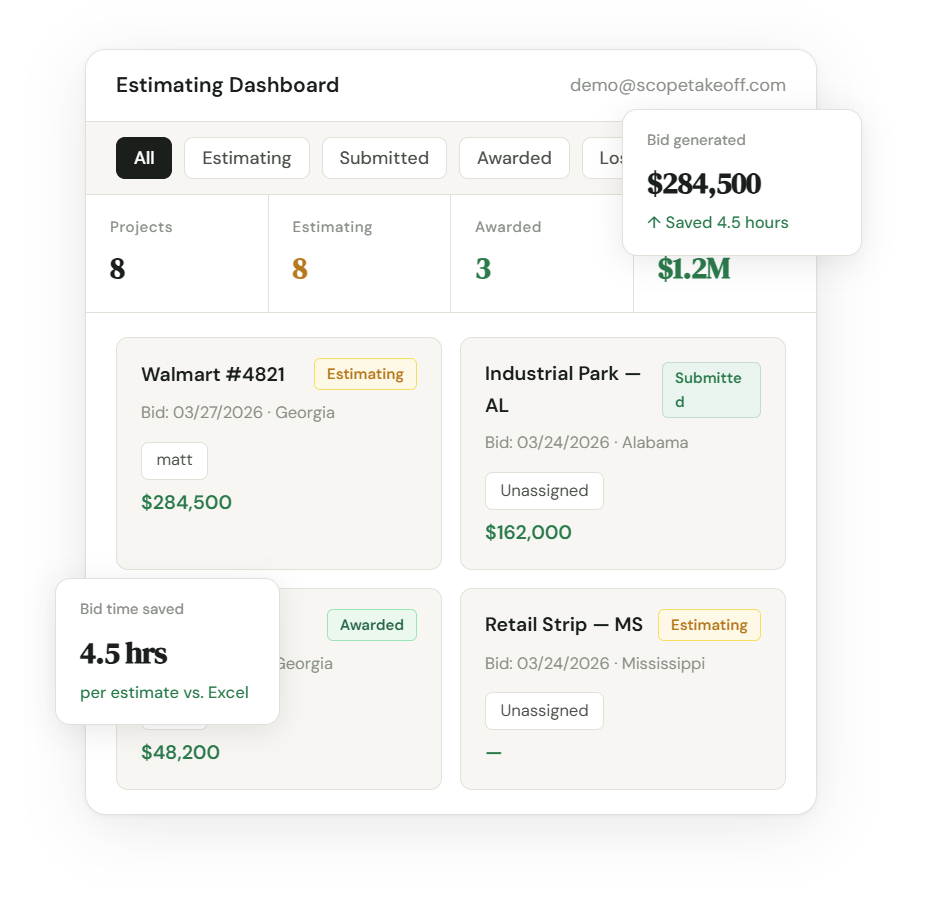
ScopeTakeoff calculates CY, rebar tonnage, forming SFCA, and all accessory quantities automatically from your plan takeoff. Upload your PDF, measure the slab, get a priced estimate in minutes.
Start free 14-day trial → Concrete · Masonry · Drywall · Painting · HVAC · Flooring — all trades included · Credit card required